Navy Current Affairs: The Silent Movements That Are Changing Our World
Most of us begin our day worrying about work, family, health, or money. We rarely think about oceans, ships, or distant seas. And yet, far away from our daily noise, something very important is always happening. Navy Current Affairs are quietly shaping how safe the world feels, how smoothly trade runs, and how stable countries remain.
How Navy Current Affairs Are Already Part of Your Life
When sea routes are safe, life feels normal. When they are not, prices rise, supplies break, and stress spreads. That’s why Navy Current Affairs are not really about war. Ships are becoming smarter. Monitoring is becoming sharper. Decisions are being taken in moments, not weeks.
US Navy News and How Power Is Shown Without Firing a Shot
In the modern world, strength is not always shown by fighting. Very often, it is shown by presence.
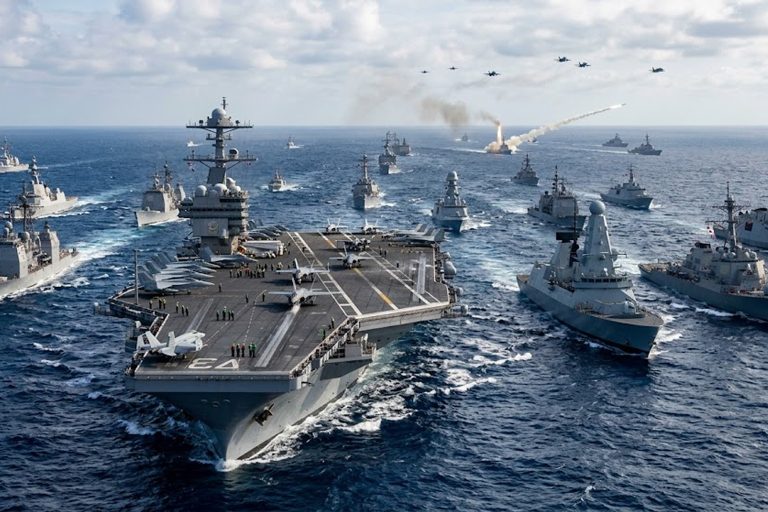
A fleet moving through a region, a joint exercise between countries, or a routine patrol can send a powerful message without a single word being spoken. This is the new language of the seas—calm, controlled, but very clear.
Countries now think carefully about every move they make on water. The goal is not to create fear, but to maintain balance. The oceans have become a place where patience, planning, and preparedness matter more than noise.
Why Students and Thinkers Follow US Navy News So Closely
Understanding Navy Current Affairs is really about understanding where the world is slowly, quietly heading. It is not about memorizing news. It is about seeing the bigger picture.
The Sea Will Decide More of Our Future Than We Imagine
The world is becoming more crowded, more competitive, and more connected. And in this world, the oceans are no longer just empty spaces between countries. They are busy highways, strategic zones, and silent stages of global planning.
In the coming years, Navy Current Affairs will become even more important—not just for governments or militaries, but for ordinary people who want stability, growth, and peace because the sea may look peaceful on the surface but beneath it, the future of the world is being carefully, quietly written every single day.
Final Thoughts: Importance of World Navy Current Affairs
If a state wants to influence global events from a distance, then it must be an acknowledged sea power. Today, he explains why navies remain the most formidable demonstration of a state’s geopolitical and security prowess. By Eric Grove for ISN If one wishes to shape the contemporary security environment to reflect one’s own and allies’ geopolitical interests one has to be a major sea power or a significant contributor to a maritime coalition. The reason is simple enough. While we call this planet ‘Earth’, it is hardly an accurate name. If one looks at us from space we inhabit a blue planet, two thirds of which is covered by water. ‘Oceania’ would be a more accurate description.
Throughout human history our capacity to use the sea for moving goods, people and resources has been vital. Until mechanical land and air transport was developed (and even after it) sea lanes were the main arteries of global communication, thereby fundamentally shaping human history in the process. Indeed, even in an increasingly globalised world ships still carry the vast majority of global trade.
That said, sea transport is still quite often taken for granted – so much so that ‘sea blindness’ is a common affliction among the world’s political elites. Yet without safe and secure sea lanes, the global economy would collapse. No more oil and gas; no more imported coal or iron ore; few foreign built road vehicles; major reductions in food supplies.
Accordingly, our dependence on the sea is as great as ever and the capacity to project sea power in the name of safeguarding economic security and geopolitical interests remains essential.
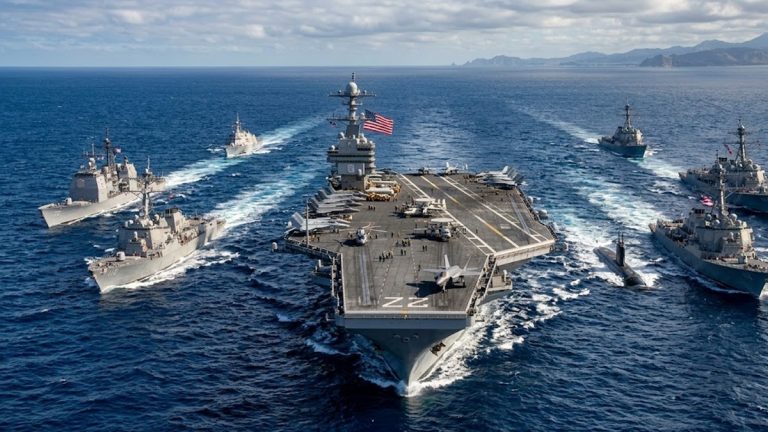
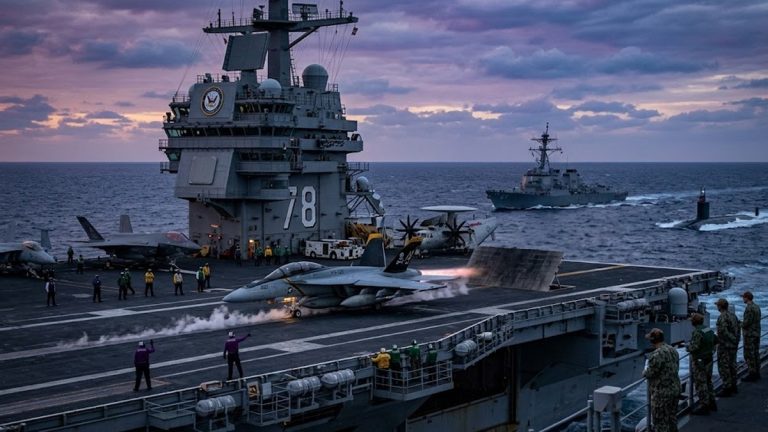
The Sea Power Jigsaw So what makes a state a bona fide frontline sea power? Part of the answer lies in the anecdote that the first question US presidents ask during times of crisis is ‘where are the carriers’? The aircraft carrier is a uniquely flexible, deployable and self-sustaining air base.
Currently, the United States’ Navy leads the way with its 11 aircraft carriers. However, given the pressures of sequestration it currently can only sustain two carriers on deployment, the USS George H W Bush in the Eastern Mediterranean and the Harry S Truman battle group in the Persian Gulf.
Indeed, given the American tilt to Asia one must entertain doubts about such a concentration in the future. Beyond the United States and its Western allies (France, Italy, Spain and the United Kingdom) other countries also clearly recognize the geopolitical importance and significance of aircraft carriers.
India’s carrier capability is well established and China is undoubtedly catching up. Despite its constitution, Japan is developing ‘helicopter destroyers’ that look remarkably like small aircraft carriers.